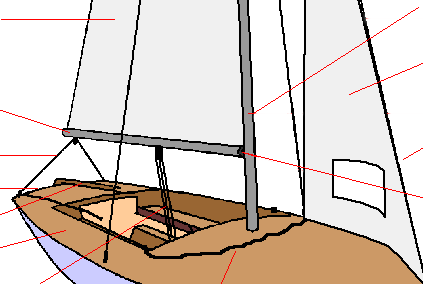
The Centreboard stops the boat from
drifting sideways when sailing upwind. Centreboards come in two flavours -
a centreboard is hinged and may be raised or lowered by pulling it backwards
or forwards. Boats fitted with centreboards are the Enterprise, GP14, Phantom
and Fireball.
A Daggerboard is a removable boat
which fits in a slot in the hull. It's raised and lowered by simply pulling
it vertically up and down. It's typically found on a Laser.
Settings are usually fully down for
beating, half way down for reaching and almost fully up for running.
It's important to make sure that
the centreboard is kept in good condition - any dinks scratches or dents can
cause a lot of drag, especially during light winds, and slow you down.
The forestay is the 2.5 mm or 3 mm wire rope which runs
from the front of the mast to the bow of the boat, supporting your mast.
On a dinghy with a foresail (a jib or genoa) the forestay
is usually slack as the job halyard is used to tension the rig. On a single
hander like a Phantom, the forestay is the main control for rig rake and tension,
and it's not unusual for a complex set of blocks to be used to allow the helm
to adjust rig tension whilst under sail.
On all boats, reducing the rig tension when the boat is
being de-rigged after sailing is a good idea because it reduces stress on
the hull.
Come on! It's the big stick that you hoist your sail up!
Seriously, masts are complex pieces of kit that usually contain halyards,
which are the ropes that you use to hoist your sails.
Masts have traditionally been made from extruded aluminium
or wood, but increasingly spun carbon fibre is being used on high performance
dinghies for two reasons - it's lighter, and it bends sideways in a gust,
reducing power.
The rake and bend of your mast
are some of the most important tweaks on your boat, and have a huge influence
on the power of the rig and it's pointing ability - the ability of your boat
to sail faster and nearer to the wind.
Jib
Sheets are the control lines which control the jib. Usually looked after by
the crew and useful to haul yourself back into the boat with when you capsize..
The Genoa or Jib is the sail at the front of the boat. It provides additional
power. A jib is a smaller sail whose foot does not normally extend beyond
the shrouds. A Genoa is a much larger sail whose foot extends further back
than the shrouds. Some classes, such as the GP14, allow either a jib, or genoa,
depending on the conditions and size of crew.
Usually made from Dacron or a Kevlar Laminate material.
The
front of your boat.
The Hull is the bit of the that keeps the water out! Typically
made from wood, some form of fibreglass or increasingly rotationally moulded
polyester.
Which is the best material to go for? Wood looks really
nice and provides a very stiff, and hence fast, boat - but it's a lot of work
to maintain. GRP is low maintenance but soft. Epoxy foam sandwich is fast,
stiff and low maintenance. Rotomoulded is as tough as old boots and zero maintenance,
but looks terrible. You takes your pick.....
The kicking strap (also known as the Vang) serves many purposes
- it keeps tension on the boom preventing a "chinese gybe", it tensions
the leech of the sail, providing power to the sail, and it acts to bend the
mast when tensioned. The mast bend flattens the sail and reduces the power
of the rig.
Many different types are available, in many different configurations.
Many modern boats are fitted with a GNAV - an upside down vang which pushes
the boom down rather than pulling it down. This gives more space in the cockpit.
Setting, in general - kicker on for beating, less for reaching
& running, lots of kicker on when it's windy!
It's generally where you sit if it's windy.
The tiller is attached to the rudder and it the device with
which the boat is steered. Usually also fitted is a tiller extension, a long
rod which is fitted to the tiller on a flexible knuckle. This allows the helm
to sit and continue to steer the boat. Dropping the tiller extension during
tacking or gybing is generally poor practice and will eventually result in
a hairy moment. Or a swim.
It's the back of your boat! Or more precisely the panel
that forms the back of your boat which stops water coming in.
Most racing boats have large holes cut through the transom,
covered with flaps, which let out large quantities of water in the event of
a capsize. Some boats, for instance a modern Phantom, have no transom at all
- they rely on speed to keep the water from entering the hull.
The mainsheet is one of if not the most important controls
of your dinghy. It serves one main purpose - to control the position of the
mainsail, and a secondary purpose - to control the tension in the leach of
the mainsail.
There are three possible methods of sheeting a dinghy -
transom sheeting, where the main is controlled from the end of the boom, centre
main where all of the pulleys are positioned in centre, and three-quarter
main, where the main starts at the rear but is controlled from a block in
the centre of the boat. This system is used on a Laser.
Centre main seems to be the prefered method of sheeting
as it spreads load on the main. You may find your boat is fitted with a centre
jammer which allows you to cleat off the main. Resist all temptation to use
this device as it will enevitably lead to a swim....
The boom is the spar which supports the foot of the sail,
allowing you to tension the foot of the sail and control the shape of the
sail.
Almost all racing dinghies are fitted with an outhaul, a
system of pulleys at the end of the boom which allow the helm to adjust the
tension in the foot of the sail - more tension means a flatter sail, which
in turn means less power (in a blow) and better pointing ability. So tension
the outhaul for beating and loosen for running and reaching.
The mainsail is the main power supply to your boat, and correct
trimming of this sail is essential to a good performance of your boat on the
racecourse.
Mainsails are usually constructed from a Dacron or Mylar /
Kevlar material, and can be radial or crosscut in construction. They will almost
always have some battens to stiffen the leach of the sail, and may in some cases
be "fully battened" (such as a Solo or Supernova) where the battens
run the full width of the sail.
There are four main controls for the mainsail - the mainsheet,
the kicker (or vang), the cunningham (or downhaul) and outhaul. You need an
understanding of the function of all of these controls to get the best out of
your boat.
These are the wires that, in a stayed rigged boat, keep
the mast from falling down. Usually 2.5 or 3 mm steel cables, they assist
in providing pre-bend in the mast, and have a great effect on the gust response
of the mast - that's to say the stiffness of the upper section of the mast
and it's ability to bend sideways slightly in a gust. Attached to the hull
with chainplates, you would be advised to keep a close eye on the condition
of the shrouds and chainplates, as any problems will likely result in rig
failure, embarressment and probably a considerable repair bill.
It's the piece of hardware that attaches the boom to the mast
- usually a device with a pin that locates into the end of the boom and swivel
that moves in 4 axis. A high stress item that is prone to breaking - check
the condition of the gooseneck itself and also the rivets that hold it into
the mast!
The
painter is the piece of rope on the front of the boat that you use to tie it
up with. Make sure it's long enough (4 metres or 12 feet, whichever you prefer)
as the rescue crew will need it at some stage to tow your boat with.